
How Industrial Composting Works: Complete Guide

Every year, the world produces over two billion tons of municipal solid waste, with a significant portion made up of organic materials. What happens to all that waste can shape the future of soil health and sustainability. Industrial composting takes the challenge head-on by turning once-troublesome organic matter into nutrient-rich soil, offering efficient solutions for both businesses and communities striving for more responsible waste management.
Key Takeaways
| Point | Details |
|---|---|
| Industrial Composting Efficiency | Industrial composting effectively processes a wider range of organic materials, minimizing waste volume and accelerating nutrient recycling compared to traditional methods. |
| Controlled Environmental Conditions | Precise management of temperature, moisture, and oxygen levels is essential for rapid decomposition and high-quality compost production. |
| Various Composting Methods | Different industrial composting techniques, such as windrow, in-vessel, and aerated static pile, each offer unique benefits and operational efficiencies. |
| Sustainability Impact | Industrial composting supports circular economy principles by transforming waste into valuable soil amendments, aiding in environmental conservation efforts. |
Table of Contents
- What Industrial Composting Means
- Industrial Composting Methods Compared
- How Industrial Composting Operates
- Operational Requirements And Controls
- Benefits And Practical Implications
What Industrial Composting Means
Industrial composting transforms vast quantities of organic waste into nutrient-rich soil through a sophisticated, accelerated process that goes far beyond traditional backyard composting methods. According to research from waste management experts, this high-tech approach enables the breakdown of materials that would typically challenge home composting systems.
The process operates under precisely controlled conditions, typically maintaining thermophilic temperatures between 32–60°C, which dramatically speeds up decomposition. These carefully managed environments allow industrial composting facilities to process complex organic materials—including items like meat, dairy products, and certified compostable plastics—that would normally remain undecomposed in standard compost bins. Learn more about composting fundamentals to understand the full scope of this innovative waste management technique.
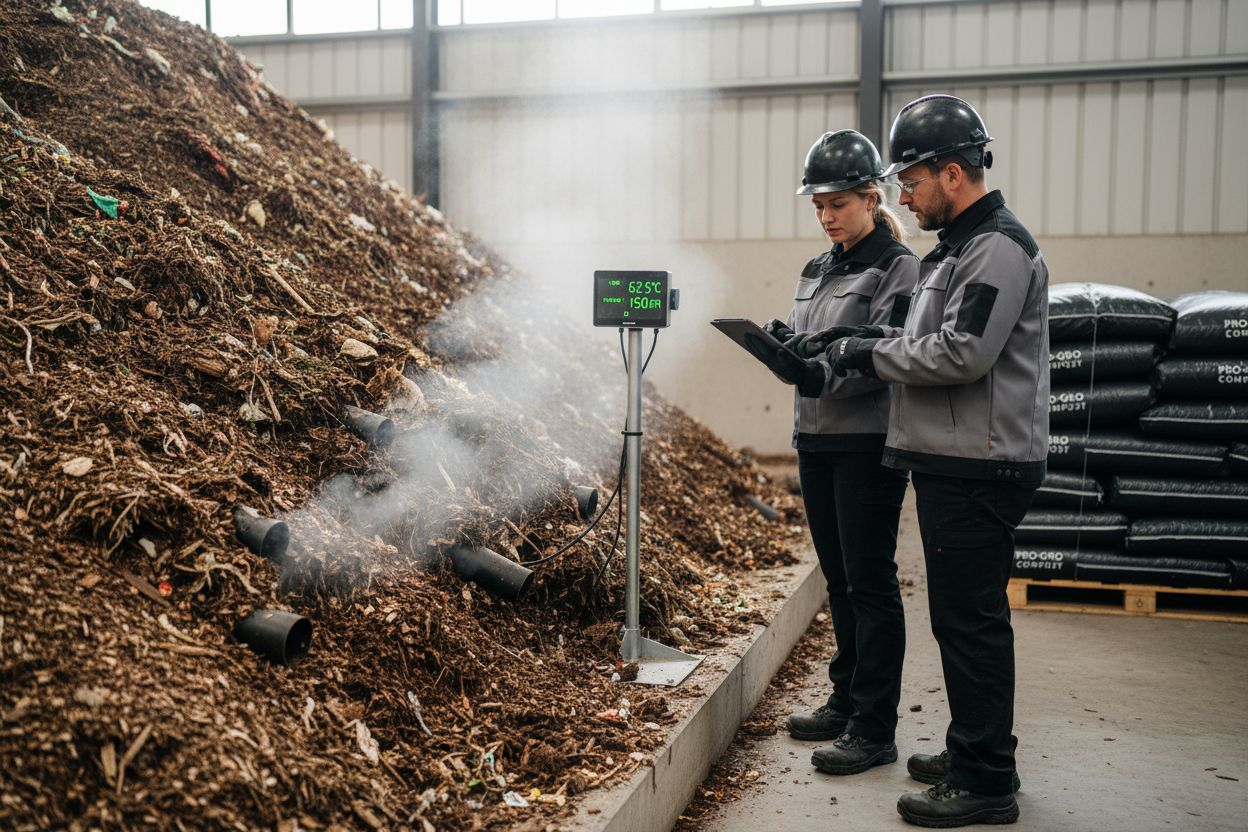
One prominent industrial composting method is aerated static pile composting, which utilizes sophisticated infrastructure like perforated piping to enable systematic, controlled decomposition. This approach offers several critical advantages:
- Rapid biodegradation of organic materials
- Precise process control
- Significant pathogen reduction
- Ability to handle large waste volumes
By transforming potential waste into valuable soil amendments, industrial composting represents a crucial sustainability strategy for businesses and municipalities seeking to minimize environmental impact and create circular waste management systems.
Industrial Composting Methods Compared
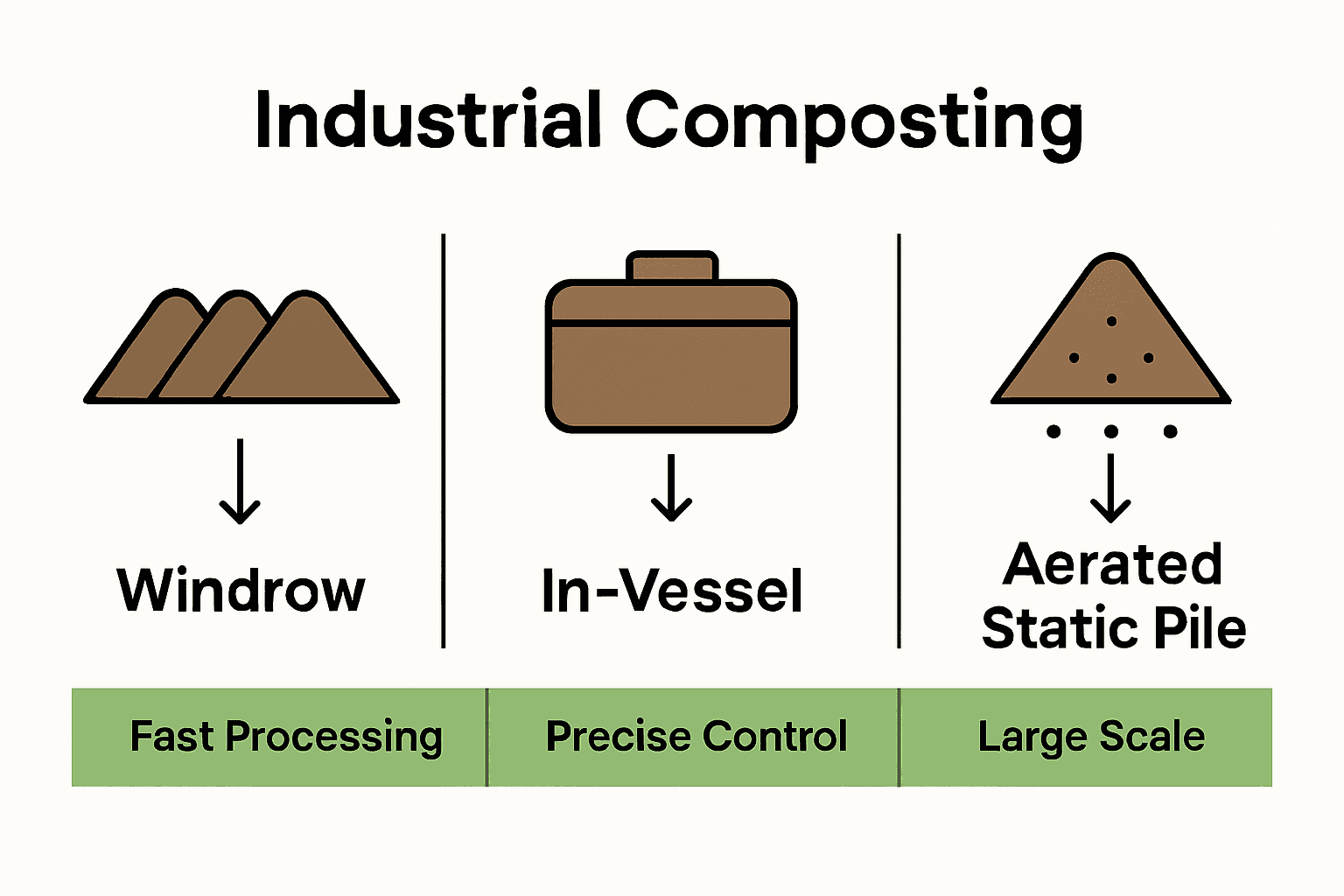
Industrial composting utilizes multiple sophisticated techniques, each designed to efficiently transform organic waste into nutrient-rich soil amendments. According to research from waste management experts, three primary methods dominate the industrial composting landscape: windrow composting, in-vessel composting, and aerated static pile composting.
Windrow composting represents the most traditional approach, involving long, carefully managed organic waste piles that are regularly turned to promote even decomposition. These elongated rows allow natural microbial activity and heat generation, making them ideal for large-scale agricultural and municipal waste processing. Research indicates these systems work best for relatively homogeneous organic materials with consistent moisture content.
In-vessel composting offers a more controlled environment by processing organic waste within enclosed containers. These sophisticated systems enable precise management of critical parameters like:
- Temperature regulation
- Airflow control
- Moisture management
- Pathogen elimination
A comparative study revealed that combined windrow-vermicomposting techniques achieve remarkable results, meeting World Health Organization pathogen standards while accelerating biodegradation processes.
This hybrid method demonstrates the potential for innovative approaches in industrial waste management, showcasing how strategic combinations can enhance overall composting effectiveness.
Here’s a comparison of the main industrial composting methods:
| Method | Environment Control | Typical Uses | Key Benefits |
|---|---|---|---|
| Windrow Composting | Moderate Open air |
Agriculture Municipal waste |
Simple setup Handles high volumes |
| In-Vessel Composting | High Enclosed containers |
Commercial food waste Urban sites |
Precise control Faster processing Hygienic |
| Aerated Static Pile | High Forced aeration |
Mixed organic waste Large-scale |
Rapid breakdown Low odor Minimal labor |
How Industrial Composting Operates
Industrial composting transforms organic waste through a meticulously engineered process that carefully balances multiple critical environmental factors. According to waste management research, the fundamental goal is creating optimal conditions for rapid, controlled decomposition that maximizes efficiency and minimizes potential environmental contamination.
In windrow composting, facilities create long, carefully managed organic waste piles that are systematically turned to enhance crucial parameters. Research indicates key operational considerations include maintaining precise:
- Carbon/nitrogen ratio balance
- Appropriate bulking agent integration
- Optimal pile dimensions
- Consistent moisture content
- Strategic turning frequency
Aerated static pile systems represent a more technologically advanced approach. These sophisticated setups utilize perforated piping connected to powerful fans that push or pull air through compost materials, enabling exceptional process control. Large-scale facilities often incorporate computerized monitoring systems that continuously regulate:
- Oxygen levels
- Temperature gradients
- Moisture distribution
- Decomposition progression
Learn more about composting fundamentals to understand how these intricate systems transform potential waste into valuable soil amendments. By maintaining precise environmental conditions, industrial composting facilities can dramatically accelerate organic matter breakdown, creating nutrient-rich compost in weeks rather than months or years.
Operational Requirements And Controls
Industrial composting facilities must navigate a complex landscape of technical and regulatory requirements to ensure efficient, safe, and environmentally responsible waste processing. According to environmental protection research, these operations demand precise management of multiple interconnected factors that directly impact decomposition quality and facility performance.
The core operational parameters are critically important for successful composting. Research indicates that facilities must maintain carefully controlled conditions, including:
- Sustained temperatures between 32–60°C
- Balanced moisture levels
- Consistent oxygen distribution
- Strategic processing timelines
These environmental controls serve multiple crucial purposes: accelerating decomposition, eliminating potentially harmful pathogens, and ensuring high-quality compost output. Learn more about composting fundamentals to understand the intricate balance required in these sophisticated waste management systems.
Beyond technical parameters, industrial composting facilities must also comply with extensive legal and environmental regulations. According to environmental protection agencies, operational requirements typically encompass:
- Obtaining specific waste processing authorizations
- Implementing robust pollution control mechanisms
- Developing comprehensive odor management strategies
- Establishing incident notification protocols
- Maintaining transparent community communication systems
By integrating rigorous technical controls with stringent regulatory compliance, industrial composting facilities can transform potential waste streams into valuable ecological resources while protecting surrounding environments and communities.
Benefits And Practical Implications
Industrial composting represents a transformative approach to waste management, offering significant advantages over traditional home composting methods. Research reveals that these sophisticated systems can process a dramatically broader range of organic materials while delivering unprecedented efficiency and environmental benefits.
According to waste management studies, industrial composting techniques enable treatment of complex organic waste streams that would challenge home composting systems. These advanced methods can effectively process:
- Meat and dairy products
- Certified compostable plastics
- Large-scale agricultural waste
- Mixed organic materials
- Commercial food waste
The processing speed is remarkably impressive. Where home composting might require several months to generate usable compost, industrial techniques rapidly transform waste in just 6–12 weeks, dramatically reducing waste volume and accelerating nutrient recycling.
Research from environmental systems experts highlights additional critical benefits. Combined windrow and vermicomposting techniques, for instance, not only accelerate organic waste breakdown but also achieve World Health Organization pathogen reduction standards. This means industrial composting doesn’t just manage waste—it creates a safe, controlled environment for converting potential environmental liabilities into valuable soil amendments, supporting circular economy principles and sustainable waste management strategies.
Choose Compostable Straws That Meet True Industrial Standards
You have just learned about the complexities of industrial composting and how it turns challenging waste into valuable resources. Maybe you worry about whether small changes can really help your business support large-scale sustainability. Does your choice of disposables actually fit into this innovative waste management process? We understand the struggle to find real solutions that are proven to break down in controlled environments, not just marketed as eco-friendly.

Take clear action today. With The Ocean Straw, every straw is designed for genuine composting at an industrial level. Discover how our plant-based straws bring peace of mind to hospitality professionals who want real results. Explore our compostable straw collection or visit The Ocean Straw homepage to start sourcing straws that match the industrial standards explained in this guide. Make your waste part of a cleaner future—choose solutions verified for the systems you just read about.
Frequently Asked Questions
What is industrial composting?
Industrial composting is a process that transforms large quantities of organic waste into nutrient-rich soil through controlled methods, allowing for a broader range of materials, including those typically challenging for home composting systems.
How does the industrial composting process work?
The process involves managing environmental factors like temperature, moisture, and oxygen levels to facilitate rapid decomposition. Methods like windrow composting, in-vessel composting, and aerated static pile composting are utilized to ensure efficient waste reduction and nutrient recycling.
What materials can be processed in industrial composting?
Industrial composting can handle a wide variety of organic materials, including meat, dairy products, certified compostable plastics, agricultural waste, and mixed organic matter. This makes it suitable for large-scale waste management.
What are the benefits of industrial composting compared to traditional composting?
Industrial composting offers several advantages, including faster processing times (6–12 weeks), the ability to process complex organic waste, and significant pathogen reduction. It supports a circular economy by converting waste into valuable soil amendments, contributing to sustainability efforts.